
Metabolic diseases such as obesity, type 2 diabetes, or fatty liver disease are on the rise globally. Chemical pollution is a well-known contributor to the development of such diseases. Plastics are part of this chemical pollution issue with over 16,000 known plastic chemicals (FPF reported).
In a review article, Food Packaging Forum (FPF) scientific advisory board member Angel Nadal from the Miguel Hernández University of Elche in Spain and colleagues, including Jane Muncke from FPF, examine the potential role of plastic-derived chemicals and micro- and nanoplastics in metabolic diseases. Specifically, they look at three chemicals in addition to micro- and nanoplastics: perfluorooctanoic acid (PFOA; CAS 335-67-1), bisphenol S (BPS; CAS 80-09-1), and diisonyl phthalate (DINP; CAS 28553-12-0).
All of these chemicals have been found in or to migrate from food contact materials (FCMs) according to FPF’s Database on Extractable and Migrating Food Contact Chemicals (FCCmigex).
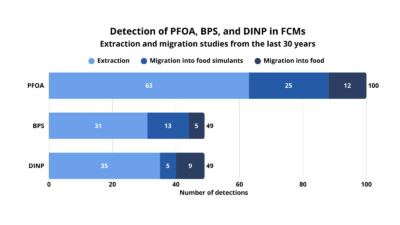 Overview of extraction and migration studies where PFOA, BPS, and DINP have been detected in food contact materials.
PFOA has been linked to several health effects and is persistent, bioaccumulative, and toxic to humans and animals. Historically, PFOA has been used in the manufacture of non-stick pans and for paper & board coatings to make them water and grease proof.
BPS is commonly used as a replacement for bisphenol A in can coatings. According to the European Chemicals Agency (ECHA), it is toxic for reproduction and an endocrine disruptor for both humans and the environment.
DINP is an additive often used in plastics to provide flexibility and softness. Due to health concerns, the substance is banned in toys and childcare articles that children can put into their mouths in the EU. DINP is a common replacement for di(2-ethylhexyl) phthalate (DEHP; CAS 117-81-7).
Nadal et al. applied the Key Characteristics framework to evaluate evidence from epidemiological, animal, and cellular studies. Evidence shows that exposure to PFOA, BPS, and DINP is linked to metabolic dysfunction, obesity, diabetes, and liver disease. Because BPS and DINP are structurally similar to other known hazardous chemicals, they are often used as replacements due to the link between chemical structure and functionality. However, structural similarity is also associated with similar toxicological properties, leading to regrettable substitution.
Although human data on micro- and nanoplastics (MNPs) are limited, animal and cellular studies indicate they may also contribute to metabolic diseases, the researchers find. However, the exact mechanisms remain unclear, and further research is warranted.
Since chemical testing is currently mostly focused on genotoxicity, chemicals contributing to many chronic diseases, including metabolic disorders, often are overlooked (FPF reported). “For regulations to effectively protect human health from the adverse impacts of exposure to plastic chemicals, such as those migrating from plastic food contact materials, testing requirements need to be expanded to address metabolic disruption as well”, the authors state. Metabolic disruption is linked to increasingly prevalent clusters of chronic diseases, including diabetes and obesity.
Nadal et al. follow up that a group-based approach to regulating chemicals, as was the case for PFAS in the EU’s Packaging and Packaging Waste Regulation, can be an effective tool to improve chemical regulation and avoid cases of regrettable substitution.
Moreover, the United Nation’s forthcoming Global Plastics Treaty could offer an opportunity to further highlight the presence and significance of hazardous chemicals in plastics, including food contact materials (FPF reported).
The authors explain that “increased public awareness of this issue can lead to a shift in demand away from single-use (plastic) food packaging towards more conscious consumption of alternatives that are less prone to migration due to their inert material properties, and that may also be more suitable for modern, more sustainable business models, such as those utilizing reusable, inert food packaging for products that are produced and consumed more locally, thereby better protecting health and the environment, as well as enabling national food sovereignty.”
Reference
Nadal et al. (2026). “Microplastics, nanoplastics, and plastic chemicals: Applying the key characteristics of metabolism disrupting agents shows reason for concern.” Environmental Endocrinology. DOI: 10.1093/enendo/wkag001