
Innovating for a safe circular economy for food packaging
Food packaging and circularity
The food contact materials (FCMs) used to make food packaging, cookware, and food processing equipment are associated with multiple environmental challenges.

Single-use plastic food packaging is a leading contributor to plastic pollution worldwide.

Energy intensive production of FCMs generates greenhouse gas emissions that accelerate global warming.

Materials with low recyclability and reliance on landfilling or incineration at end of life limit a transition to a more circular economy.
Innovations such as materials made from algae, agricultural by-products, or chemical recycling aim to address these issues. Also, novel systems are being scaled, such as reuse networks or industrial composting. However, the latest scientific evidence shows that many novel approaches in this complex space are overlooking some critical issues.
This fact sheet explores what questions entrepreneurs, innovators, and investors need to ask themselves to ensure new solutions do not become tomorrow’s problems or a business liability.
Chemical complexity and inertness
Even though many novel FCMs are made from renewable resources, they are still chemically complex materials that can contain hazardous, unknown, or untested substances. Just because something is “natural” (e.g., made from algae or agricultural waste), does not necessarily mean it is chemically safer. This is because the manufacturing of such materials still requires many different ingredients, and they can be contaminated with pesticides, environmental contaminants, or generate non-intentionally added substances (NIAS) that are often difficult to test for, identify, and determine the safety of. These novel materials also often exhibit non-inert properties, which allows any present hazardous chemicals to migrate from them into food and expose consumers under normal conditions of use.
FCMs made from recycled materials can carry similar risks, especially plastics and paper-based materials. Studies show that adding recycled content to a material can increase the amount of harmful chemicals present due to contamination during recycling. Similarly, biomass used to manufacture FCMs can be contaminated during processing and production. Reusable materials also need to be chemically safe and consider external factors that can increase the release of harmful chemicals or micro- and nanoplastics, such as intense use, material ageing, and cleaning with high temperatures and harsh detergents.
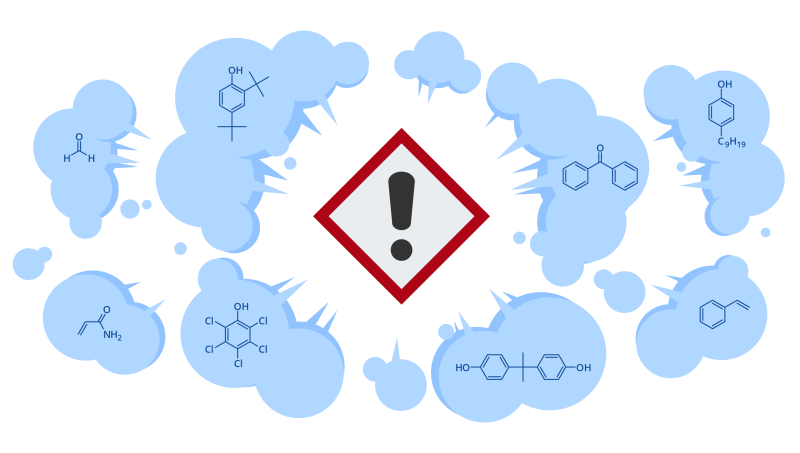
Consumers are growing more conscious of their health and of the impacts chemicals in their daily lives can have, especially in the context of foodstuffs. Scientific evidence shows that current regulatory requirements for food packaging and other food contact articles are inadequate and not protecting consumers from exposure to harmful chemicals. As both scientific evidence and regulations continue to develop, companies may be made liable in the future for harmful chemicals found in their products. Proactive innovation and testing that considers chemical safety now can both protect consumers today and prevent business liabilities later. This can also be a competitive advantage for first movers.

The importance of infrastructure
Just as trains need tracks to ride on, FCMs that are compostable, recyclable or reused need the appropriate infrastructure at scale to actually work. Investment in and development of fit-for-purpose infrastructure is important to plan for.
For materials labeled as compostable (or biodegradable) to fully degrade, they may need industrial composting facilities that are available locally and at scale. Proper testing is needed to confirm under which conditions (e.g. temperature, oxygen level) a material degrades. Products labeled as compostable and sold in areas without the needed infrastructure are misleading and frustrating for consumers. Currently, many of these products are sold in areas without available infrastructure, and they end up being landfilled or incinerated with other waste, making claims potentially subject for greenwashing. The same goes for recycling infrastructure. Just because a product is labeled as “recyclable” does not mean it will be recycled if the appropriate infrastructure is unavailable.
Consumers are increasingly aware of the mismatch between promises and action, which can erode brand trust, reduce sales, and increase the potential for legal liabilities. Regulations are also being considered or have already been implemented to review green claims and hold companies accountable for misrepresenting the impacts and proper waste management of products. Developing the infrastructure needed to scale truly sustainable FCMs will require shared investments, proper policies that create incentives, and clear communication across the value chain.
Practical questions for innovators and investors of novel FCMs
Are you abiding by current and potential future rules and regulations on FCMs and products made from them in your target markets?
Do you have a strategy for assessing the risk of and testing for NIAS?
Is your material chemically complex? Is it inert? What are the potential migrating chemicals and their associated health risks?
Are you checking for the known priority chemicals of concern that could be addressed in FCMs and avoided?
Are you an investor or innovator who could help develop the testing technology to better assess the chemical safety of materials and products? This remains an important gap, and more investment and research is needed to make better testing widely available.
Does the novel FCM have environmental impacts beyond CO2 emissions, such as degradability concerns in the natural environment, water use, biodiversity impacts, or other chemical pollution, etc.?
How are you avoiding greenwashing and unfounded claims? Do reproducible, evidence-backed results support your claims? Do you use correct terminology when labeling materials to avoid misleading consumers and regulators?
Are you basing your investment decisions on the latest, high-quality science for environmental and human health impacts?
Resources to help you answer these questions
Want to learn more about food contact chemicals? Check out our crash course.
Identify which known chemicals should be prioritized for phase out and avoidance from novel FCMs using our Food Contact Chemicals Priority (FCCPrio) List. Focus first on tier 1 chemicals when screening your supply chain and carrying out testing.
Learn from the experience of other organization’s working towards safer innovation: Advice for organizing lab testing from PlasticList
Avoid regrettable chemical substitutions in your product by screening your ingredients with the FCCgroup app.
Compare the environmental and human health impacts of many different foodware and food packaging options using the free, evidence based Understanding Packaging (UP) Scorecard.
Learn more about the need for new chemical safety testing approaches for FCMs in the webinar: “Food Contact Materials: A road map to improved safety testing”.
Browse the Food Packaging Forum’s other fact sheets and databases to learn more about the chemicals used to make food packaging (FCCdb), the food contact chemicals that can migrate from food contact articles (FCCmigex), and the food contact chemicals that have been found in human (FCChumon).
Additional resources
Want even more resources to get familiar with food contact materials and health? Check out our other fact sheets, background articles, and fact bites.


