
FCMiNo database
A systematic evidence map exploring micro- and nanoplastics in foods from plastic food contact articles.

About FCMiNo
Small plastic particles in the millimeter to nanometer range, also known as micro- and nanoplastics (MNPs), are present in foodstuffs. The normal and intended use of plastic food contact articles (FCAs) including food packaging and food processing equipment is a source of MNPs into food. Common actions that can release MNPs into food include opening a bottle or brewing tea. However, FCAs have never before been systematically assessed as a source of MNPs.
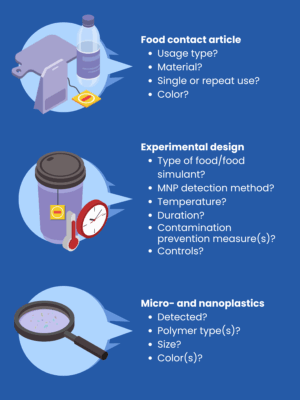
To address this knowledge gap, the Database of MNPs from Food Contact Materials (FCMiNo) maps the scientific evidence for MNPs detected in foodstuffs or food simulants that have been in contact with all types of plastic FCAs. The database details the material and use of the FCA, the type of experiment that was conducted and medium analyzed, if MNPs were detected, and if yes, the MNPs’ polymer types and size categories. FCMiNo also depicts the reliability of the data in answering whether the FCA was a potential source of the detected MNP and includes links to the respective references.

Background
MNPs have been detected in a variety of foods and beverages, leading to widespread human exposure. Their presence is commonly linked to environmental contamination, while food packaging and other food contact articles (FCAs) as a source have received little attention. This is the case even though FCAs are commonly made of plastic, and their normal and intended use (e.g., bottle opening, tea brewing, shaking) is known to lead to the abrasion and release of MNPs into foodstuffs.
Therefore, we systematically compiled the FCMiNo database to provide an overview of MNPs that have been detected in foodstuffs or food simulants in contact with all types of plastic FCAs. We then evaluated if the data provides evidence for a link between the detected MNP and the plastic FCA. A previously published protocol provides details on the approach of the systematic evidence mapping that formed the basis of FCMiNo.
Watch lead author Lisa Zimmermann answer some questions about this study’s methods, results, and implications!
Key findings
Currently, the FCMiNo database comprises 103 references and 600 entries. Fifty entries are rated highly reliable (i.e., their data quality and study design allow for the assessment of whether the FCA is a source of the detected MNPs). The systematic evidence mapping indicates that the normal and intended use of some plastic food contact articles (FCAs) leads to the release of MNPs into foodstuffs. Further, it shows that highly reliable data on MNP migration from FCAs into food are scarce. Most published scientific studies currently available are not designed to identify the origins of MNPs in foodstuffs.
Implications
The outcomes from FCMiNo suggest that plastic food packaging and processing equipment are most probably relevant sources of human exposure to MNPs. However, the scarcity of highly reliable data on MNP migration from FCAs into food prevents evidence-based measures to reduce human MNP exposure via FCAs. This calls for a harmonized testing and reporting approach, as well as for a systematic characterization of material- and use-related MNP releases. By mandating MNP migration testing for FCAs, regulations could help to better protect human health.
Search the MiNo Database
The freely available, interactive dashboard below allows you to use the FCMiNo database in an easily accessible and searchable way. We recommend using the Chrome, Brave, or Edge web browsers when using the dashboard. The Mozilla Firefox browser sometimes results in display errors.
Getting started: The dashboard shows (i) experimental data, (ii) entry reliability, and (iii) references. It can be expanded into full-screen mode by clicking the double-sided arrow in the bottom right corner. Check out the video on the right for a quick introduction on how to search the dashboard and find the data you’re most interested in.
Frequently Asked Questions
The interactive dashboard above allows you to search and filter the data on micro- and nanoplastics (MNPs) that have been detected in food or food simulants in contact with a plastic FCAs.
Overall, the database comprises 600 database entries coming from 103 published scientific references. The filter panel summarizes and allows users to filter for:
- What was tested? This includes the data on the food contact article, i.e., its usage, its main food contact material, and whether it is single or repeat use.
- How was it tested? This specifies:
- if the entry originated from study design , which is appropriate for causally linking detected MNPs with the FCA as the source. One example is a kinetic/dynamic study design were several MNP measurements are made over time and/or with increasing temperature. If MNP incidence increases over time or with increasing temperatures, a causal link is demonstrated.
- the food or food simulant the MNPs were analyzed in or if FCA surfaces have been investigated for the abrasion of MNP particles
- What was found? This refers to the MNPs and specifies if plastic particles were detected and if yes, of what size category (i.e., nano, micro, meso) and polymer types.
- What is the reliability of the results? This specifies how reliable the respective database entry is to answer the research question “does the MNP detected in the food/food simulant originate from the FCA?”
In the data view, you are shown aggregated information on several questions related to MNPs detected in foodstuffs that were in contact with a plastic FCA. Here are a few examples of possible questions are answered by selecting the appropriate filters in the dashboard:
- How many studies have analyzed microplastics in a certain foodstuff in contact with a certain plastic FCA?
- In which foodstuffs have microplastics been analyzed? In which have they been detected?
- Are microplastics s more commonly detected in food/food simulants or nanoplastics?
- How many data entries are highly reliable, i.e., establish a causal link between the MNP and the plastic FCA?
- Looking at the highly reliable data, which FCAs have been associated with the release of MNPs?
- How often have glass bottles (with a plastic lid) or metal cans (with a plastic lining) been in studies regarding MNP release?
The reference view shows you the published studies behind the data and their reliability rating. In this view, you can apply the same search and selection criteria as in the data view. There is also the option to search for authors and title keywords. The DOI or another URL is included for most references to quickly link to the underlying source. Currently, the complete or filtered reference lists cannot be exported. Example questions you can answer in the reference view are:
- Which references have detected nanoplastics in food/food simulants?
- How many studies have looked at mesoplastics?
- Which studies have investigated food processing & transport equipment?
- When have studies on specific FCAs, foods, or MNP combinations been published?
One database entry corresponds to information related to one experimental setup, i.e., the combination of one FCA, one food/food simulant, and associated MNP(s).
FCMiNo considers plastic particles of any shape and with a size of <1 µm as nanoplastics and with a size between 1 and <1000 µm as microplastics following the definitions according to ISO/TR21960:2020. It further includes “mesoplastics” for all the plastic particles with a diameter of 1-10 µm following the definition of Hartmann et al. 2019.
FCAs were included if at least one part of the article was known or assumed to be made of plastic. This means, if the main FCM is not plastic (e.g., in the case of a glass bottle, or a metal can), but contains an additional FCM for functionalization that is made of plastic (e.g., lid, lining, and coating).
To assess the reliability of the studies, we critically appraised and scored the (1) general data quality, (2) the material identification method, (3) the polymer type reported for the MNPs and the FCA, and (4) if the study design is appropriate to assess causality between the MNP and the FCA. Depending on the scores an entry received in all four steps, we considered it of high, medium, or low reliability. Importantly, criteria 1 rates the data quality regardless of our research question while criteria 2-4 inform how well the study design and data reporting allowed us to answer our research question, i.e., if there is a causal relationship between the detected MNPs and the FCA. This means that studies showing causality were considered highly reliable. Nevertheless, studies with low reliability regarding an FCA being a source of MNPs detected in foodstuffs can still have high general data quality (criteria 1)and may be appropriate for answering other research questions.
We decided to not include information on MNP quantity in the tool for several reasons:
(1) There are few highly reliable studies.
(2) The different experimental setups, methods applied, and metrics used to report MNP quantities complicate their unified representation in the dashboard and impede the comparison of quantities reported by different studies.
MNP quantity information might be added to the tool in the future.
FCMiNo is a living database that occasionally gets updated. As such, absolute numbers shown in the dashboard may change when updated. In the future, we may also make small edits to the underlying data of the tool or the interactive tool itself, for instance, to further facilitate its usability or broaden its applicability.
In all works that reference the FCMiNo database, please cite both the journal article as well as this website:
Zimmermann, L., Geueke, B., Parkinson, L.V., Schür, C., Wagner, M., Muncke, J. (2025) Food contact articles as source of micro- and nanoplastics: A systematic evidence map. npj Science of Food. DOI: 10.1038/s41538-025-00470-3
Food Packaging Forum Foundation (2025) “FCMiNo Database.” https://foodpackagingforum.org/mino
We aim to update the database periodically in the future, however, exact timelines are not yet finalized. Accurate curation of systematic datasets requires significant time and resources. FCMiNo was first published in 2025. We will announce when new data are included in the database on both this website and via our newsletter.
For additional questions not answered here or in the journal article, please send us an email: info@fp-forum.org. We will respond to you as soon as possible. We also appreciate constructive feedback to help us improve the database and dashboard.
Publications
An update on micro- and nanoplastics in foods from plastic food contact articles: protocol for a systematic evidence map
Zimmermann, L., Geueke, B., Schür, C., Wagner, M., Muncke, J.
2026, Evidence-Based Toxicology. DOI: 10.1080/2833373X.2026.2638039
Food contact articles as source of micro- and nanoplastics: A systematic evidence map
Zimmermann, L., Geueke, B., Parkinson, L.V., Schür, C., Wagner, M., Muncke, J.
2025, npj Science of Food. DOI: 10.1038/s41538-025-00470-3