

Chemical Safety of Food Contact Materials
The safety of different food contact chemicals depends on their material properties. This fact sheet explains why some materials are inherently safer for human health than others, highlights current testing challenges, and outlines why current regulations may not be protecting human health as much as we think.
Inertness as key property for safety
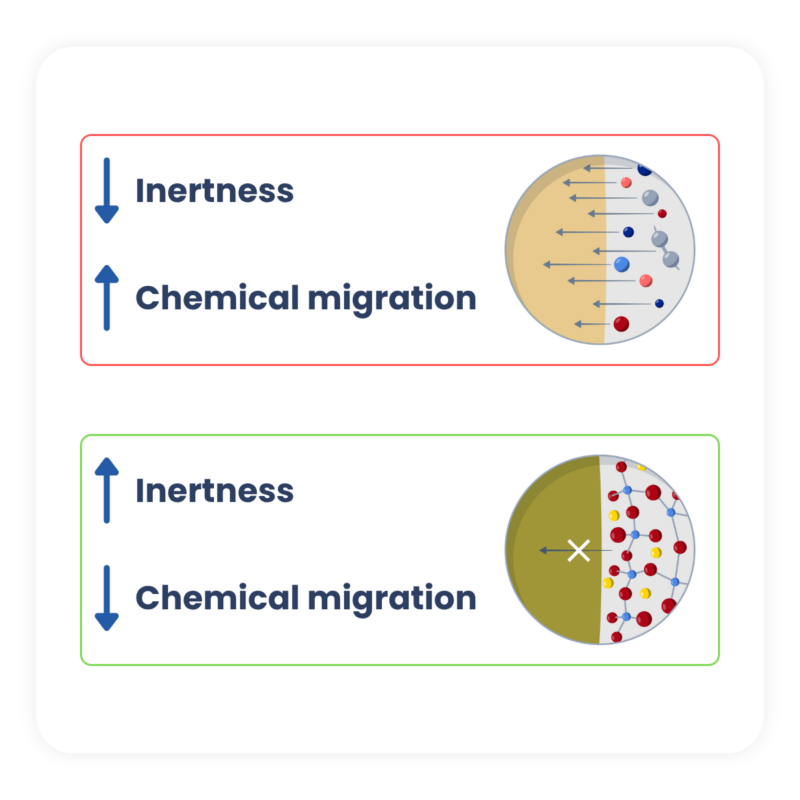
Food contact materials (FCMs) can transfer the chemicals they contain into foodstuffs in a process called chemical migration. The extent of migration depends on which chemicals are contained in a material, their amounts in the material, properties of the foodstuff the material touches, and properties of the material itself. Fundamentally, migration depends on a material’s inherent inertness, meaning to what extent chemicals in the material are able to move into and out of it.
For example, materials with high inertness have no or very low amounts of chemical migration, while materials with low inertness are prone to high chemical migration. Different conditions of the food and final product such as temperature, storage time, form of the food, and size of the container can further influence the rate of chemical migration (see our fact sheet on packaging and health).
Chemical complexity as a key property for safety
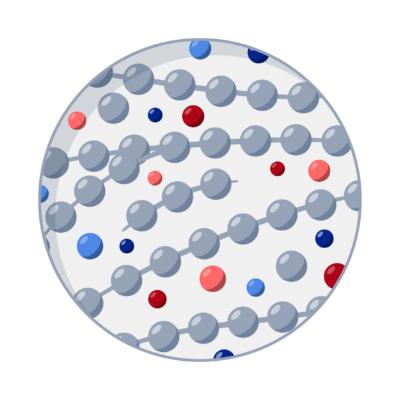
A second important property to help assess the inherent safety of a material is its chemical complexity. For example, plastic and paper-based materials have high chemical complexity, with many different ingredients used in their production. As a result, they can contain hundreds to thousands of different synthetic chemicals, many of which are known to be hazardous to human health. Recycling of plastics and paper-based materials can increase the chemical complexity even more.

Plastic and paper are also materials with low inertness. High complexity combined with low inertness means that many chemicals can move more easily in and out of the material, increasing the chance consumers will be exposed to any hazardous chemicals present.

In comparison, other food contact materials such as stainless steel, glass, and ceramics are different in that they are less chemically complex and have much higher inertness. This means they contain far fewer chemicals, and they can release far fewer chemicals into food. Less complexity and higher inertness reduce the chance for consumers to be exposed to hazardous chemicals, making them inherently safer for human health. Their high inertness also makes these three material types better suited for reuse and recycling because the materials do not degrade over time.
Missing data and non-intentionally added substances (NIAS)
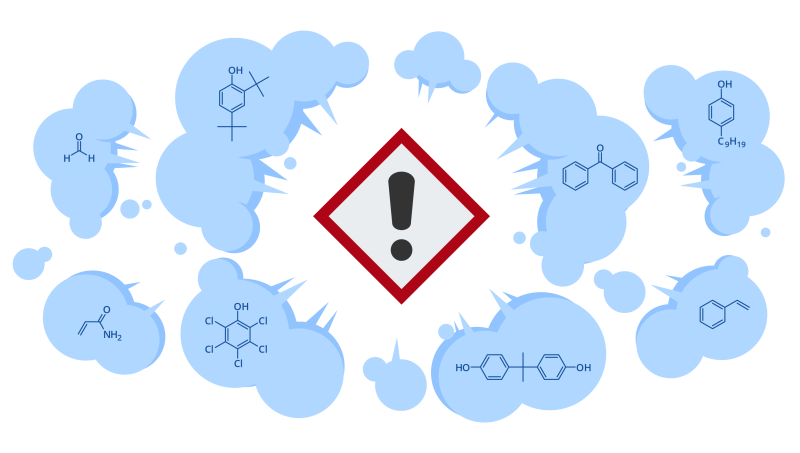
There are more than 15,000 known food contact chemicals across all types of food contact materials, but 81% of these chemicals are missing important data on their potential health impacts. Current legally required safety testing checks for migration of a set of known chemicals used to produce FCMs, but thousands of other chemicals can unintentionally contaminate FCMs during their manufacture or use.
These are known as non-intentionally added substances (NIAS), and they add to a material’s chemical complexity. NIAS are often very difficult to identify, test for, and determine the safety of. Today, most NIAS are entirely unknown and untested for their safety in FCMs on the market. Up to 100,000 NIAS are estimated to exist across all FCM types. Using materials that are highly complex and have low inertness (such as plastics and paper) greatly increases the chance that hazardous NIAS migrate into foodstuffs and expose consumers.
Toxicity testing gaps
Scientists in the field are concerned that FCM regulations today are not adequately protecting human health. This is because current FCM migration and toxicity tests mandated by law are limited to a set of known chemicals, cannot properly consider all the NIAS that may be present, and do not screen for the wider range of health impacts that can occur even at very low levels (e.g., endocrine disruption). To address current knowledge gaps and improve safety testing of all chemicals in FCMs, leading experts have called for the development of new scientific methods that reliably test all final FCMs for a wider range of potential health impacts, including from NIAS, before they are allowed onto the market.
Additional resources
Want even more resources to get familiar with food contact materials and health? Check out our other fact sheets, background articles, and fact bites.